Handheld Inkjet Printer for Seed Packaging & Processing Across Australia & New Zealand
From grain belt paddocks in Western Australia to boutique seed houses in Canterbury, New Zealand — the challenge is the same: how do you get clear, reliable batch codes, lot numbers, and expiry dates onto every seed bag, every time, without expensive fixed-line equipment?
The Seed Industry's Coding Problem
Seed packaging and processing facilities across Australia and New Zealand face a regulatory and operational reality that many other industries don't: every single bag, pouch, or container must carry accurate, legible product information — variety name, lot number, batch code, germination rate, use-by date, country of origin, and increasingly, a QR code or barcode for full supply chain traceability.
The challenge isn't knowing what to print. It's finding an affordable, flexible, and reliable way to print it — especially when you're dealing with different bag sizes, different substrates (woven polypropylene, paper, kraft, laminate), and production runs that can range from 50 bags to 50,000.
Fixed conveyor-mounted coding machines work well for high-volume, uniform production lines. But most Australian and New Zealand seed operations don't run like a soft-drink bottling plant. Seasonal production cycles, variable bag formats, rural locations, and the need to move the printer between storage sheds and packaging areas all make a handheld inkjet printer the practical, cost-effective answer.
A handheld inkjet printer eliminates the need for fixed coding infrastructure entirely. One person, one device, and you can code seed bags anywhere on the property — no conveyor, no compressed air lines, no specialist installer required.
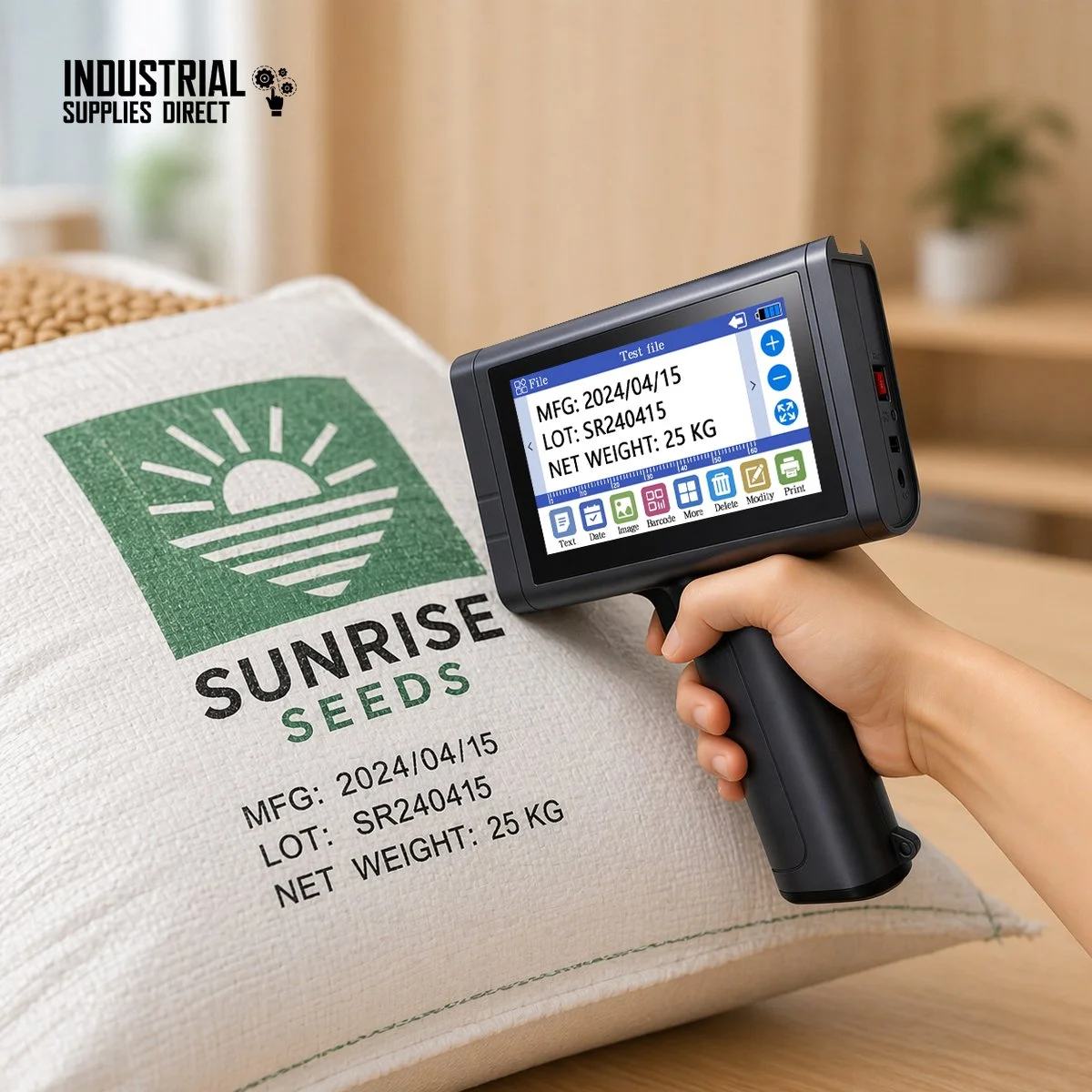
Why a Handheld Inkjet Printer Suits Seed Operations
Unlike beverages or pharmaceuticals, the Australian and New Zealand seed industry is characterised by its geographic spread, seasonal peaks, and enormous diversity of products. A single operation might package grass seed, vegetable seed, cover crop mix, and wildflower blend — each requiring different print content on different bag types within the same week.
This is precisely why handheld inkjet technology has seen rapid adoption across the sector. Here's what makes it the right fit:
No Fixed Installation
Move between sheds, trucks, and processing areas freely. No mounting brackets, no pneumatic lines, no electrician required.
Instant Product Changeover
Switch between print templates in seconds on the touchscreen. Ideal for facilities packaging multiple seed varieties per shift.
Works on Every Surface
Woven poly bags, paper kraft, laminate pouches, cardboard cartons — the right ink choice handles them all with crisp results.
Low Entry Cost
A fraction of the cost of a fixed TIJ or CIJ system. No maintenance contracts, no spare parts inventory, no downtime fees.
Built for Dusty Environments
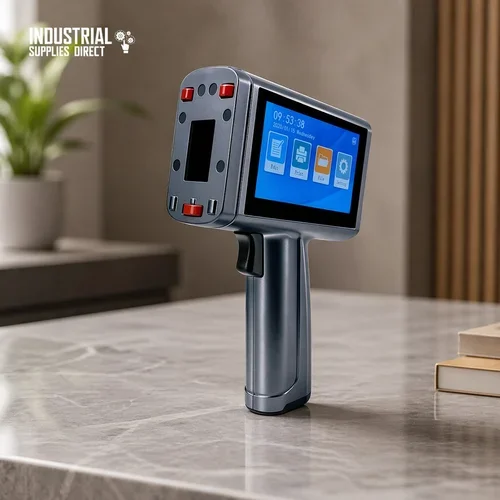
The M21's industrial-grade metal body is designed for the reality of grain sheds, packing sheds, and outdoor processing — not office conditions.
Simple to Operate
A 4.3-inch capacitive touchscreen means any team member can set up and operate it — no specialised training needed.
In seed operations, the same facility that's packaging 25kg bags in the morning might be filling 1000kg bulk bags in the afternoon. Flexibility isn't a luxury — it's the entire job.
— Common operational reality for Australian seed packagersWhat Seed Packagers Need to Print
Compliance requirements in Australia (under the Agricultural and Veterinary Chemicals Code Act and state-based seed certification schemes) and in New Zealand (under Biosecurity Act requirements and the NZ Seed Certification Scheme) mandate that seed bags carry specific information. A handheld inkjet printer can produce all of it:
Lot & Batch Numbers
Every seed lot must be uniquely identified for traceability back to the source paddock, grower, and season. Handheld inkjet printers allow you to print sequential or variable lot numbers directly onto the bag surface — no labels required.
Compliance · TraceabilityExpiry & Use-By Dates
Germination viability degrades over time. Accurate expiry dates protect consumers and shield your business from liability. Date printing can be automated with real-time date offsets built into the print template — set the offset once, print continuously.
Date Coding · ViabilityGermination Rate & Purity Percentage
Quality-tested seed must display germination percentages and purity data. Variable data printing allows this information to change per batch without reprinting labels or replacing pre-printed bags.
Quality Data · Variable PrintBarcodes & QR Codes
Retail seed product and commercial wholesale seed shipments increasingly require 1D barcodes or 2D QR codes for inventory scanning, point-of-sale systems, and farm management software integration. The M21 prints both at up to 600 DPI.
Barcodes · QR · Retail ReadyVariety Name & Country of Origin
Particularly important for exported seed from Australia and New Zealand, country of origin marking is a biosecurity and trade compliance requirement. Print it directly on the bag alongside variety, species, and any treatment chemical codes.
Export Compliance · BiosecurityLogos & Brand Graphics
For retail seed brands, a handheld inkjet printer can also reproduce logos, product graphics, and brand marks at high resolution — turning a plain kraft bag into a branded product without the cost of pre-printed packaging.
Branding · Retail · GraphicsThe M21 Handheld Inkjet Printer — Built for Australian Conditions
The M21 from Industrial Supplies Direct is specifically designed for demanding industrial and agricultural environments. Its industrial-grade metal body isn't marketing language — it reflects the reality of what a printer faces in a working seed shed: dust, humidity, rough handling, and operators who don't have time to treat equipment delicately.
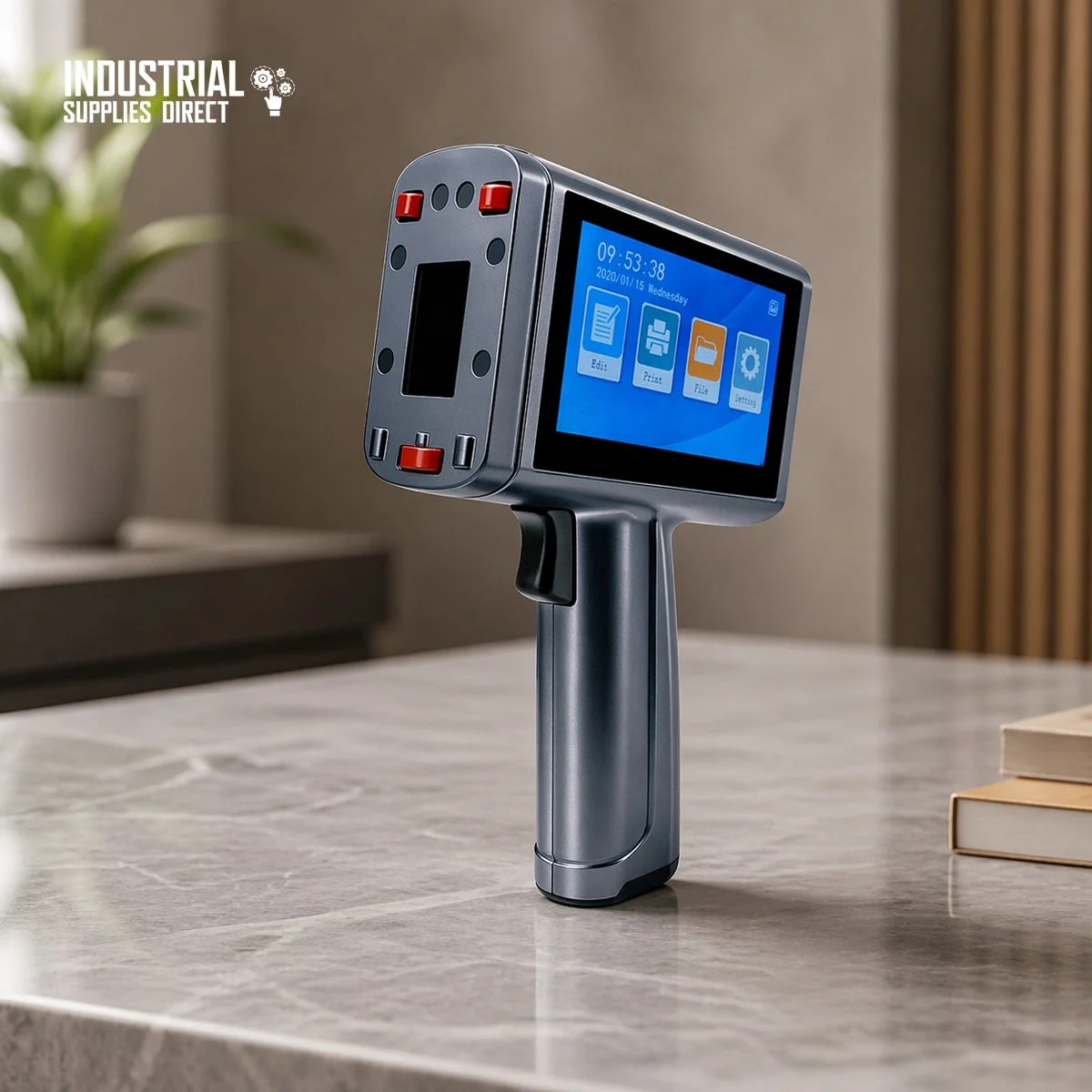
Technical Specifications
| Specification | M21 Details |
|---|---|
| Print Height | 12.7mm / 25.4mm (selectable) |
| Resolution | Up to 600 DPI — sharp barcodes, QR codes, fine text |
| Nozzle Technology | TIJ 2.5 (Thermal Inkjet) |
| Display | 4.3" Capacitive Touchscreen — responsive, large, glove-friendly |
| Connectivity | USB-C + Bluetooth — wireless template upload from phone or PC |
| Processor | Quad-core 1.5GHz — fast template switching |
| Operating Temperature | 0–40°C — suitable for refrigerated seed storage and hot sheds |
| Humidity Range | 10%–80% RH — handles coastal and high-humidity NZ conditions |
| Body Construction | Industrial-grade metal — impact resistant, long service life |
| Ink Types | Water-based (porous), Solvent (non-porous), UV (high durability) |
| Print Content | Text, dates, logos, QR codes, barcodes, variable data |
Woven polypropylene seed bags: use solvent-based ink for fast-drying, adhesion to the non-porous surface. Paper or kraft bags: water-based ink absorbs cleanly and dries quickly without smearing. Outdoor-stored seed bags: UV ink provides the best resistance to sunlight and moisture exposure.
Real Applications Across Australian & New Zealand Seed Industries
The seed industry is more diverse than most people outside it realise. Here's how different segments across Australia and New Zealand are using handheld inkjet technology today:
Grain & Pasture Seed — Australia's Grain Belt
Across Western Australia, South Australia, Victoria, and NSW, large-scale grain and pasture seed operations handle seasonal volumes that can't justify year-round fixed coding infrastructure. A handheld inkjet printer is deployed during the packaging season, then stored during the off-season — saving capital while delivering full compliance. Print content typically includes lot numbers, germination dates, net weight, and state biosecurity declarations.
Vegetable & Horticultural Seed — Southern Australia & NZ
The premium vegetable seed sector — concentrated in Tasmania, Victoria, South Australia, and New Zealand's South Island — requires precision coding on smaller retail packets and wholesale sachets. High-resolution 600 DPI output ensures barcodes scan reliably at retail point-of-sale, and QR codes link to online germination guides and growing information — increasingly a consumer expectation in the specialty seed market.
Grass & Fodder Seed — New Zealand
New Zealand's world-leading grass and fodder seed industry exports globally. Every exported bag requires country of origin, phytosanitary lot references, and biosecurity compliance data. A handheld inkjet printer handles the variable data requirements of mixed export consignments — different lot codes on different bag sizes — without the need for costly label changeovers.
Cover Crops & Blended Mixes — Regenerative Agriculture Sector
The rapidly growing cover crop and regenerative agriculture seed sector across both countries often operates at smaller scale with high SKU diversity. A single operator might blend and bag 20 different mix formulations per week, each requiring unique print content. A handheld inkjet printer with bluetooth template management means new formulations are added to the print library on a laptop and transmitted wirelessly — no delays, no reprinting labels.
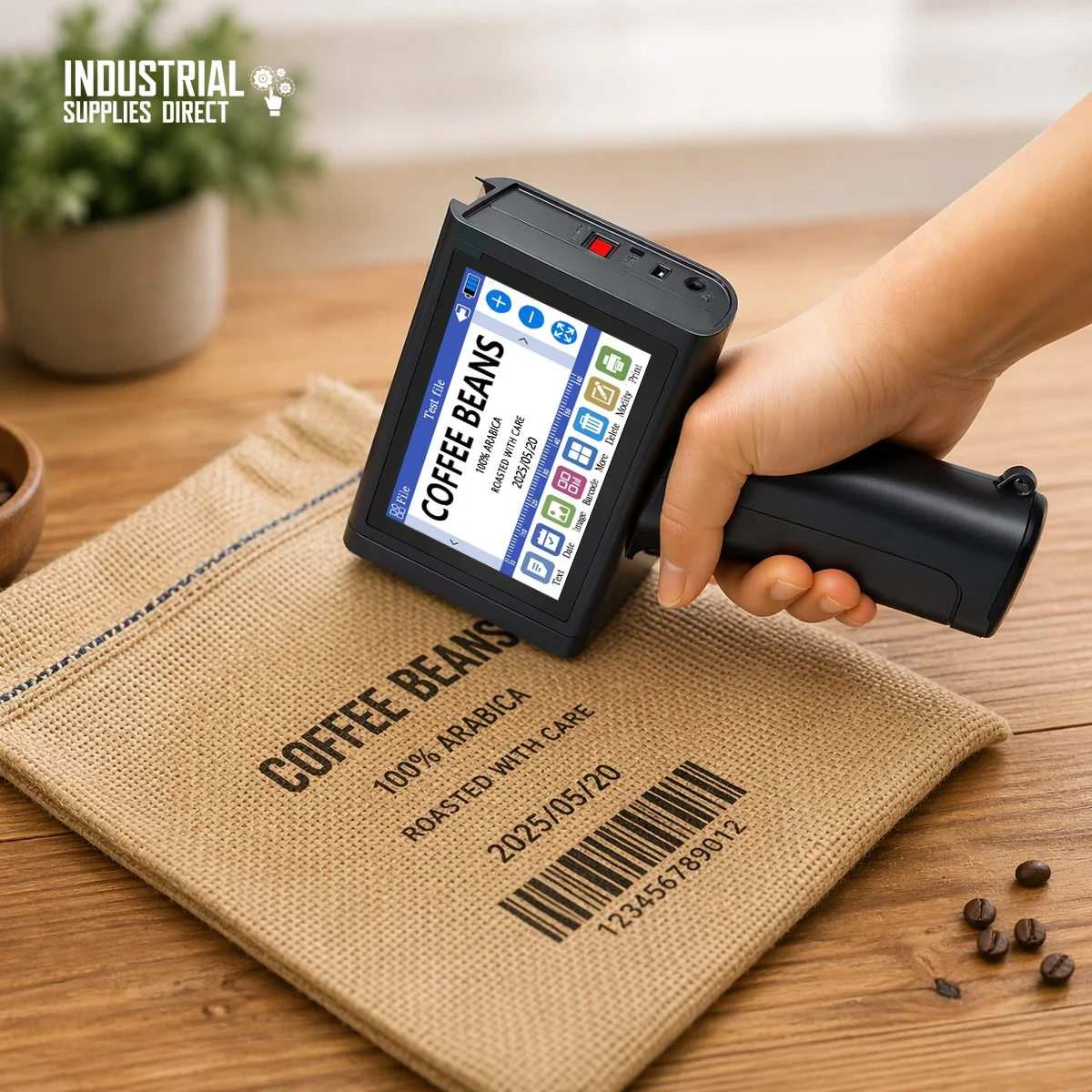
Traceability & Compliance in the ANZ Seed Industry
Both Australia and New Zealand have regulatory frameworks that make accurate seed coding not just good practice — it's a legal requirement in many circumstances.
Australia — Seed Certification and State Schemes
Australia's seed industry operates under both federal and state-based regulation. The Australian Seeds Authority (ASA) administers national seed certification schemes for grasses, cereals, and forage crops. Certified seed must carry lot identification, purity and germination data, and certification grade marking. State biosecurity agencies add further requirements for interstate movement declarations. All of this information must appear on or attached to the bag — printed directly with a handheld inkjet printer is the most efficient solution.
New Zealand — Seed Certification Scheme
New Zealand's seed certification operates through Asure Quality and adheres to OECD seed certification scheme requirements for export. Certified seed bags must carry the OECD label and lot traceability information. Direct printing of lot codes onto bags that are also fitted with official certification labels is standard practice among major NZ seed exporters.
Always verify current labelling requirements with your state or national seed certification authority. Requirements differ between certified seed, non-certified commercial seed, and exempt categories. A handheld inkjet printer provides the flexibility to update print content quickly as requirements evolve.
How to Set Up and Use a Handheld Inkjet Printer for Seed Bags
One of the strongest arguments for handheld inkjet technology in seed operations is the simplicity of getting started. Here's the typical workflow from unboxing to first production bag:
Select the Right Ink Cartridge
Choose solvent-based ink for woven polypropylene or plastic-coated bags, water-based for paper or kraft, and UV ink for outdoor-exposed bags or where maximum durability is needed. Swap cartridges in seconds — no tools, no mess.
Create Your Print Template
Use the 4.3" touchscreen to build your template directly on the device, or design it on a PC and transfer via Bluetooth or USB-C. Add text fields, date/time stamps, barcode or QR code generators, logos, and variable data fields.
Set Variable Data Rules
Configure automatic date offsets (e.g. "use by = today + 24 months"), sequential batch number counters, or link to external data sources via Bluetooth for lot numbers pulled from your farm management or ERP system.
Print & Inspect
Hold the M21 against the bag surface and trigger the print. The TIJ 2.5 nozzle delivers up to 600 DPI output that dries within seconds on most surfaces. Do a quick scan test with your phone if using barcodes or QR codes to verify readability before committing to a full production run.
Store & Maintain
Between sessions, store the printer horizontally with the cap on the cartridge. No daily purge cycles, no solvent flushing, no maintenance regime. Simply replace the cartridge when it runs out — the same way you'd replace a printer cartridge at home.
Handheld Inkjet vs. Other Seed Bag Coding Methods
Before committing to any coding solution, it's worth understanding how handheld inkjet compares to the alternatives most commonly used in seed packaging operations:
| Method | Best For | Limitations |
|---|---|---|
| Handheld Inkjet (M21) | SME and mid-scale seed packagers; variable bag formats; rural locations; seasonal operations | Manual operation — not suited to fully automated high-speed lines above ~2,000 bags/hour |
| Pre-printed bags | Single high-volume SKU with fixed product details | Zero flexibility for variable data (lot, date, germination %); minimum order quantities; expensive reprints |
| Label applicators | Adding traceability labels to pre-printed retail packs | Label cost per unit; label adhesion failure on cold or dusty bags; slower than direct print |
| Fixed CIJ / TIJ printer | High-volume single-format production lines (beverages, large-scale processors) | Fixed installation; high capital cost; requires conveyor integration; overkill for most seed operations |
| Manual stamp / roller | Lowest-cost option for simple date or lot stamping | No barcodes, no graphics, poor consistency, ink management issues, operator fatigue |
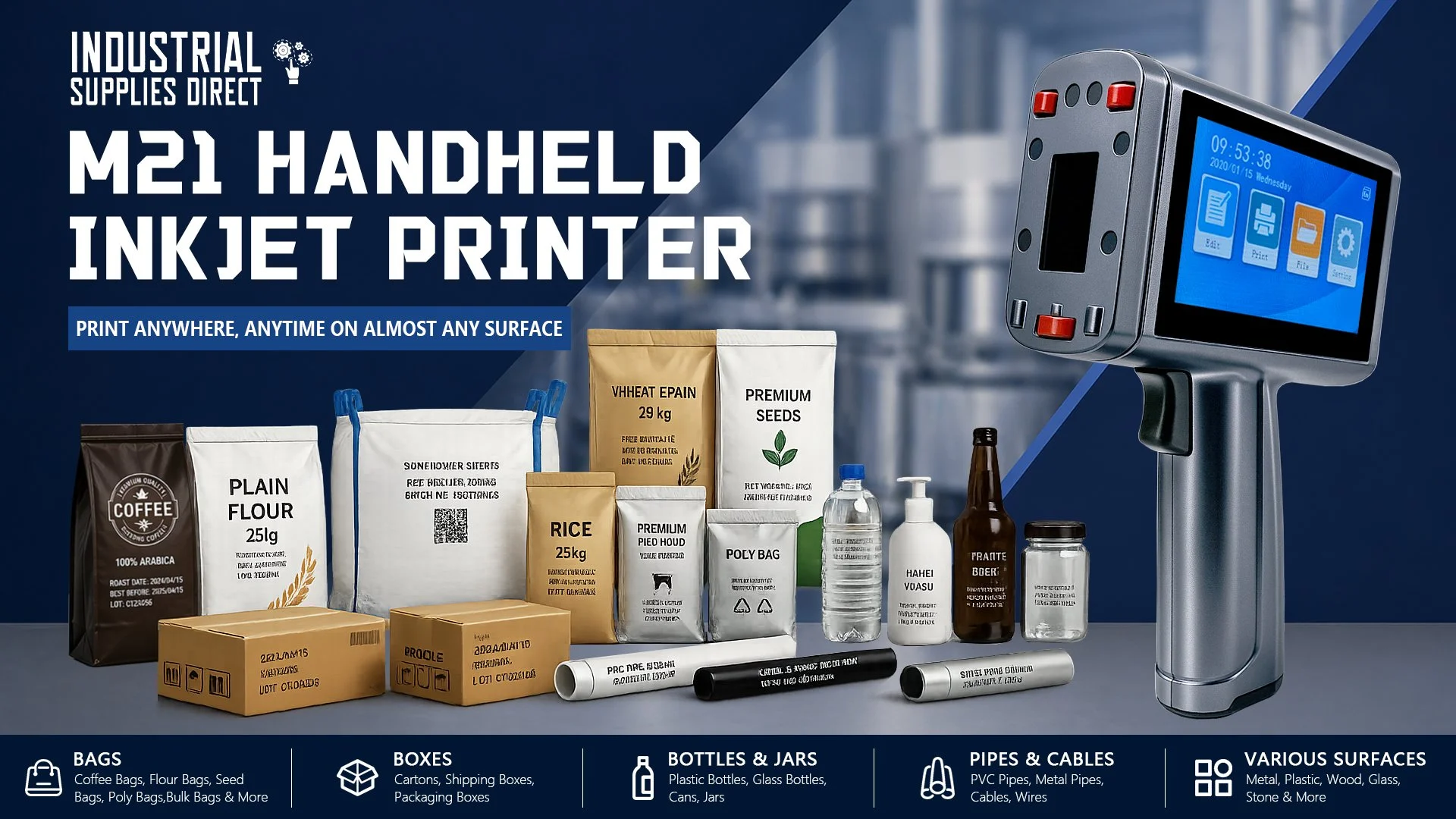
Frequently Asked Questions
Yes. Woven polypropylene (PP) is a non-porous surface, so you'll need to use solvent-based ink with the M21. Solvent inks are specifically formulated to bond to synthetic surfaces, drying quickly and producing a clear, durable mark that resists smearing and handling abrasion. Always do a small test print on your specific bag material and allow 30 seconds before handling to confirm dry time in your ambient conditions.
Requirements vary by seed type and certification status, but commonly required information includes: species and variety name, lot or batch number, net weight, germination percentage and date tested, purity percentage, country of origin, and any treatment chemical codes. For certified seed under ASA schemes, additional scheme-specific data is required. Check with your state agriculture department or the Australian Seeds Authority for current requirements applicable to your seed type.
Yes. The M21 generates QR codes at up to 600 DPI, which is sufficient for reliable scanning by most smartphone cameras and dedicated barcode readers. You encode the URL or data string of your choice into the QR code template. Many seed companies use this to link to digital germination certificates, growing guides, or variety information pages — adding value for the end purchaser while keeping the bag design clean.
Cartridge life depends on the density and size of your print content, but as a general guide, a standard cartridge delivers approximately 10,000 to 15,000 prints at typical seed bag coding content (lot number, date, small barcode). Your print supplier can provide more specific yield estimates based on your template design. Replacement cartridges are available directly from Industrial Supplies Direct.
The M21 is rated for operating temperatures of 0°C to 40°C, making it suitable for cool-room seed storage environments. Note that very cold bag surfaces can slow ink drying — allow a few additional seconds before stacking or handling bags printed in cold conditions. Solvent-based inks generally perform better than water-based in cold environments.
Absolutely. The M21 is fully suitable for large format bags. The 12.7mm or 25.4mm print height options allow for clearly legible coding on large bag faces. Many operators print directly onto the bag before or after filling — the printer is simply held against the surface and triggered. For very large production runs, two operators can work in parallel with separate M21 units on the same template.
Getting a Handheld Inkjet Printer for Your Seed Operation
Industrial Supplies Direct supply the M21 Handheld Inkjet Printer direct to agricultural and seed processing operations across Australia and New Zealand. Based in Launceston, Tasmania, we stock the M21 with all three ink types (water-based, solvent, and UV) to suit every bag substrate you're likely to encounter.
We can provide:
- →M21 unit supply — single unit and multi-unit orders for larger operations
- →Ink cartridge supply — ongoing ink supply matched to your bag substrate
- →Setup support — template creation guidance and ink selection advice for your specific application
- →Product brochure download — full M21 technical specifications for internal procurement review
Get in touch via email or phone and describe your seed operation — bag types, print content required, approximate volume — and we'll confirm the right ink type and advise on any template setup requirements specific to your use case.
Get the M21 for Your Seed Operation
Contact Industrial Supplies Direct today for pricing, ink selection advice, and to arrange a demo. We supply across Australia and New Zealand.
Handheld Inkjet Printer Australia: The 2026 Industrial Sourcing Guide
Find the best handheld inkjet printer Australia wide with our 2026 guide. Learn to code on metal & plastic, lower costs & beat the heat. Source smarter today.